
FASTQ files (Reads)
An analysis starts from counts. FASTQ files are counted first, in Reads on the Data page; the counts then open as a single-cell analysis for 10x Genomics data, or as a bulk analysis.
1. Open Reads
FASTQ files do not go on the start screen of an analysis, or in the upload area of the Datasets tab: both take counts, and both stop when you drop reads there. Open Data in the left menu, then Reads at the top right of the page.
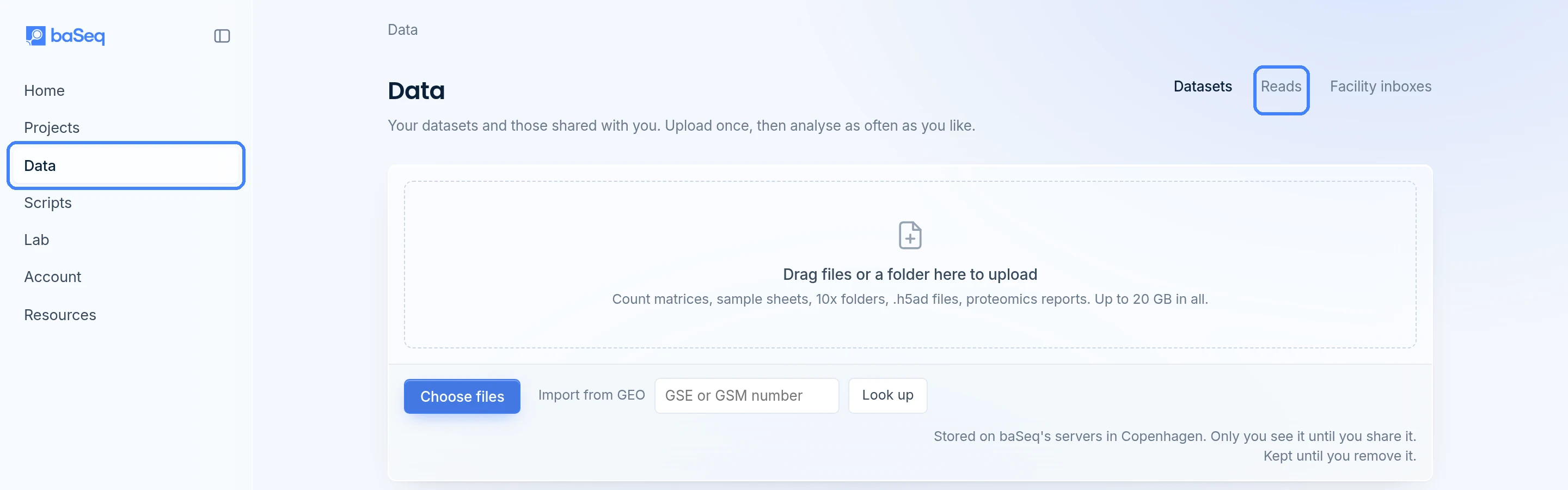
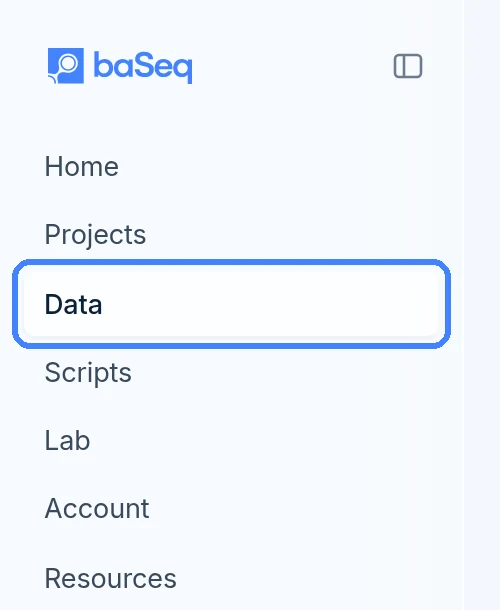

If there is no Reads on your Data page, write to [email protected] and we switch it on for your account.
2. Drop the folder of FASTQ files
On the Reads tab, drop the folder that holds the FASTQ files on Drop a folder of FASTQ files, or press Choose a folder. Send the folder as your sequencing facility or 10x Genomics delivered it:
- Every lane of every sample, paired or single reads, as
.fastq.gzor.fq.gz. The samples are read from the file names, for examplepbmc_1k_v3_S1_L001_R1_001.fastq.gz. - Index reads (
I1,I2) can stay in the folder; they are set aside. - Add a sample sheet (
.csvor.tsv) to the folder if you have one.
The run is named after the folder, unless you type a name under Name first. Keep the page open while the files upload. If the connection drops, open the run from the list on the Reads tab and it picks up where it stopped.
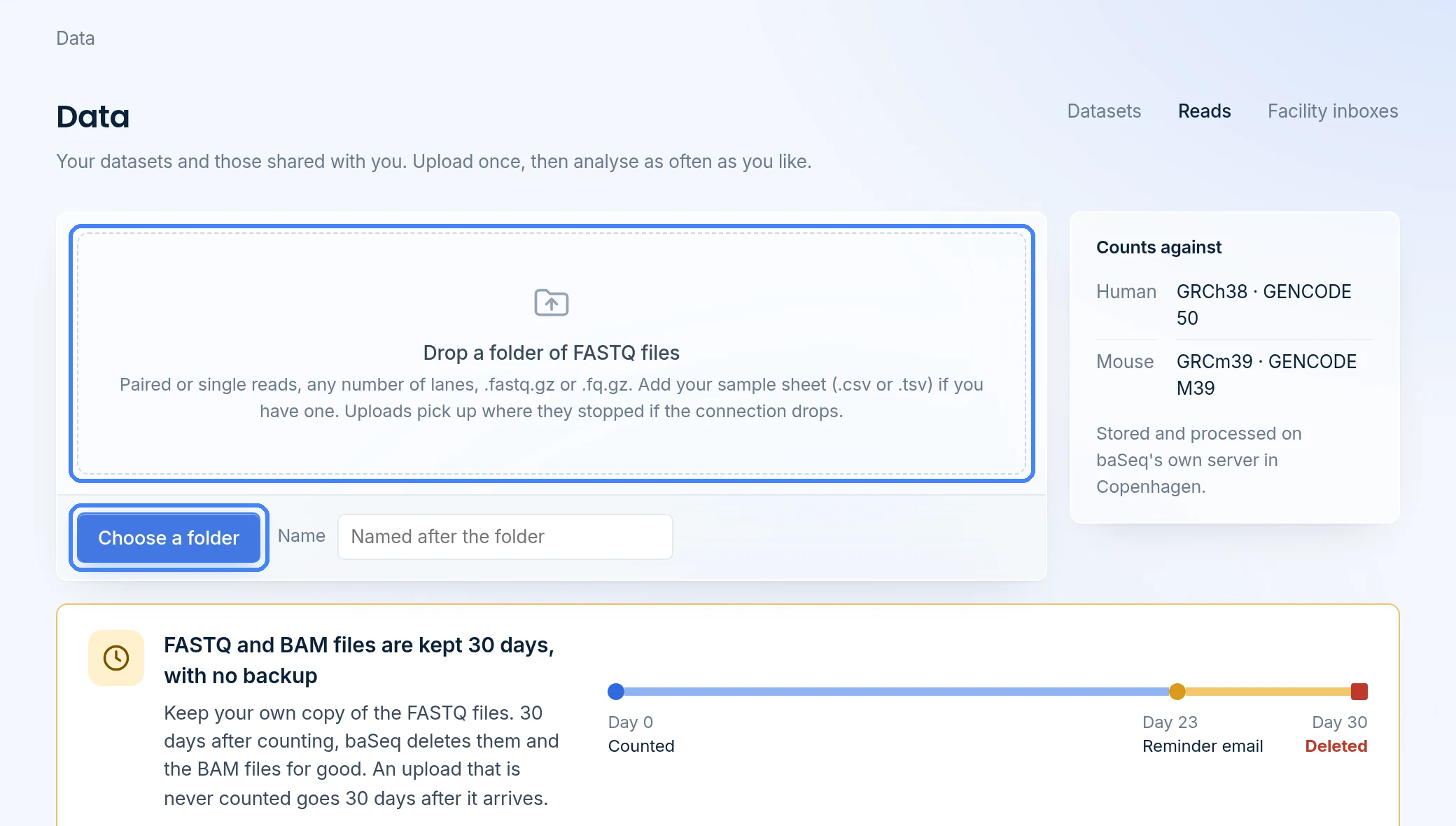
baSeq deletes the FASTQ and BAM files 30 days after counting and never backs them up. You get a reminder email a week before. The counts, the quality report and the methods are kept and backed up.
3. Choose the organism and run the pre-flight
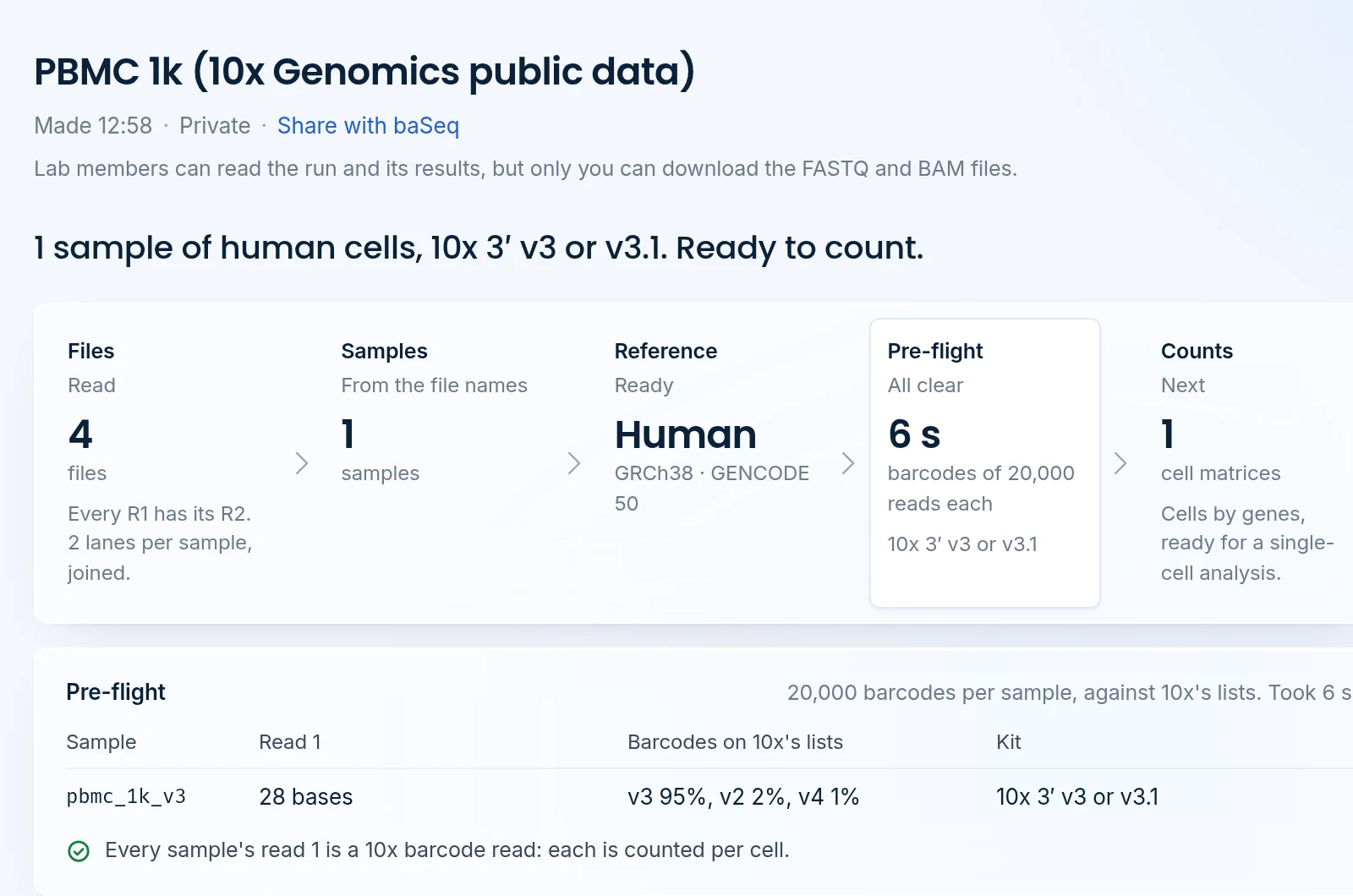
When the files are in, the run's page opens. Choose the organism under The reads are from and press Choose. The pre-flight runs with it unless you untick Run the pre-flight too: a look at each sample's first reads that takes from a few seconds to a few minutes.
- 10x Genomics data is recognised from the cell barcodes in read 1, and the pre-flight names the kit (3′ v2, v3 or v3.1, or v4). You do not choose it.
- Bulk RNA-seq is checked for the species, the strand, the sex of each sample and its share of ribosomal RNA.
Anything worth a look before counting is listed on the page, with what you can do about it.
4. Start counting
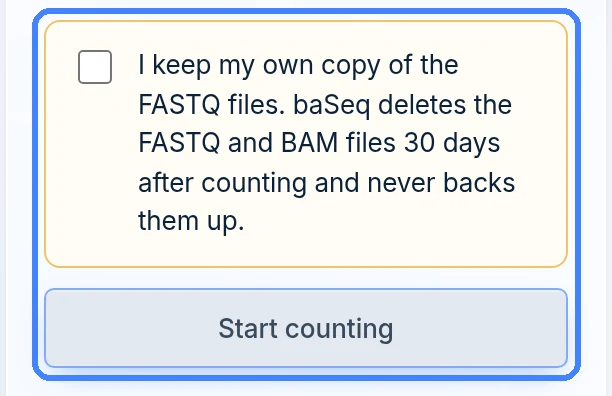
Tick I keep my own copy of the FASTQ files and press Start counting. You can close the page: baSeq emails you when the run is counted. Counting takes from minutes to a few hours, depending on the number of reads.
A 10x sample is counted per cell with STARsolo, with the settings that match Cell Ranger: the cell barcodes are matched to 10x's list, reads are counted on exons and introns as Cell Ranger 7 does, and the cells are told from the empty droplets as Cell Ranger does. A bulk sample is trimmed, aligned and counted per gene, with a MultiQC quality report.
5. Start the analysis
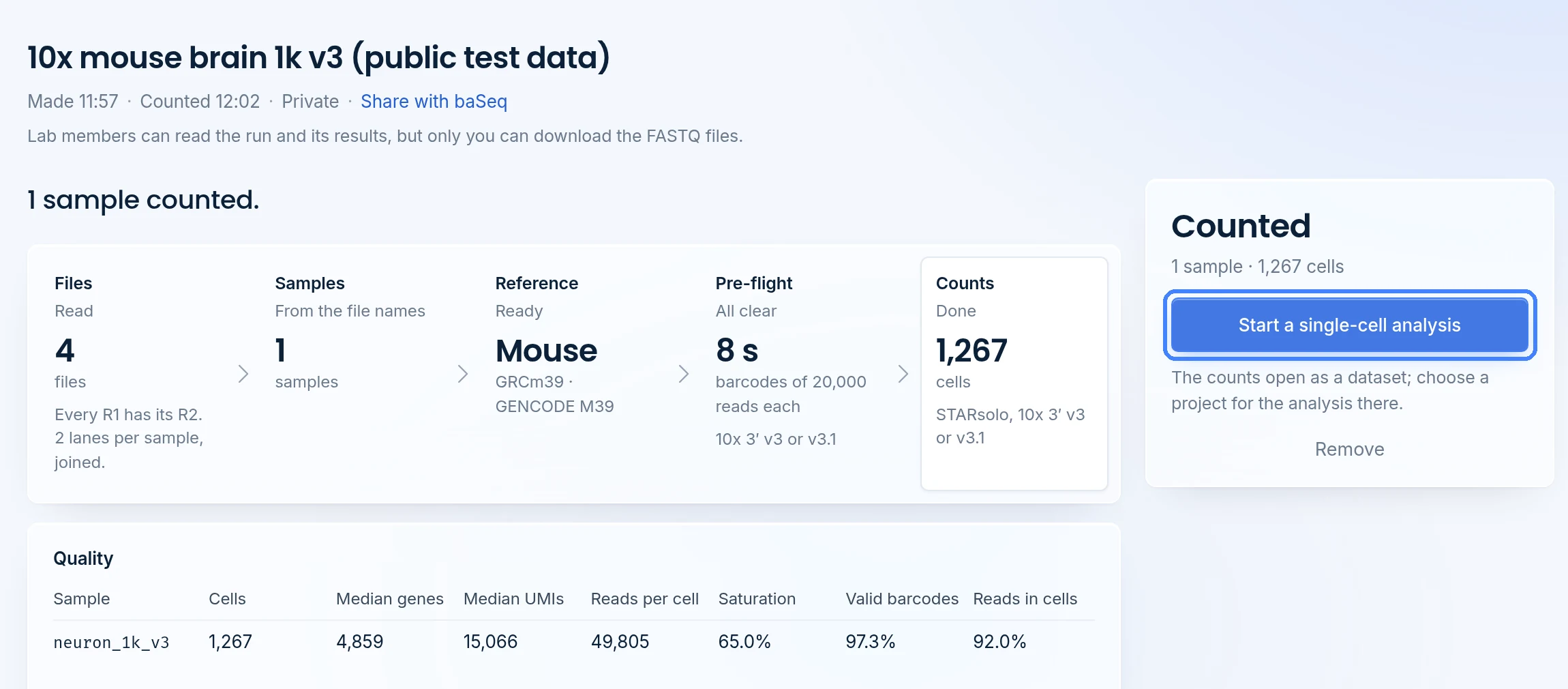
When the run is counted, press Start a single-cell analysis (for 10x data) or Start a bulk analysis. The counts become a dataset on the Datasets tab and its page opens: press Analyse, choose the Project, and press Start analysis. The analysis opens with the samples to review, as after any upload.
What Reads counts
| Data | Counted |
|---|---|
| 10x Genomics single-cell, 3′ gene expression (v2, v3, v3.1, v4) | Per cell, with STARsolo, into a single-cell dataset |
| Bulk RNA-seq, whole transcript or 3′ tag-seq (such as QuantSeq), with or without UMIs | Per gene, into a bulk dataset |
Reads counts human reads against GRCh38 (GENCODE 50) and mouse reads against GRCm39 (GENCODE M39). 10x 5′, Multiome and Flex runs are not counted yet.
The quality of a 10x run
Each sample's row holds the numbers Cell Ranger's summary shows, so you can compare them with a run of your own.
| Column | What it is |
|---|---|
| Cells | The barcodes told apart from empty droplets as cells. |
| Median genes | The genes found in the median cell. |
| Median UMIs | The molecules counted in the median cell. |
| Reads per cell | The sample's reads divided by its cells. |
| Saturation | The share of reads from molecules already seen. High saturation means that more sequencing would find few new molecules. |
| Valid barcodes | The share of reads whose cell barcode is on 10x's list. |
| Reads in cells | The share of the counted reads that come from cells rather than empty droplets. |